Pain Reprocessing Therapy
Around 1.2 billion individuals worldwide are suffering from chronic pain. There are multiple approaches to treating chronic pain, such as physical therapy, medications, interventional procedures like those that we perform in our clinic, or surgeries. All of them have proven their efficiency, yet some patients still suffer from chronic pain, although their doctors assured them that there is no structural problem to fix, and they don’t have an explanation for the chronic pain they have.
If you are one of them, you are probably wondering: If I don’t have a structural problem, does that mean that my pain is unreal? That is a valid question, and the answer is that your pain is absolutely real, and you can get rid of or reduce it with new approaches that differ from the approaches you already know.
How do we feel pain?
If you touched a hot pot, for example, you would feel the pain and take your hand away. Have you wondered how this happens? When you touch something hot, your peripheral sensory nerves send signals to your brain, and your brain interprets those signals as physical danger, so your brain sends signals that make you feel physical pain and orders your muscles to move your hand away from the danger. And that is how your brain protects you.
This also applies to the one who has low back and leg pain because of a herniated disc pressing on a nerve. In this case, your brain interprets this as a physical danger and sends signals to feel pain in the area that is related to that nerve, so once one feels the pain, they are going to know that there is a problem, and they are going to seek help by visiting a physician.
By now, we all know that any pain you feel is generated by your brain. In the previous examples, your brain interprets the signals as physical danger, which shows as physical pain, and all of that is to protect you.
Sometimes, the brain misinterprets the signals as dangerous ones, and the pain is felt in one part of the body or multiple parts, although there is no structural problem, and in this case, traditional treatments do not give any relief.
Neuroplastic pain is when the brain makes learnt neural pathways for an emotional feeling, like anxiety, or a movement with physical pain due to misinterpretation of some signals in repetition.
How to eliminate neuroplastic pain?
By using techniques that fix the misinterpretation of an emotional feeling or an activity as a physical danger. One of those techniques that proved its effectiveness is Pain Reprocessing Therapy (PRT).
What is Pain Reprocessing Therapy (PRT)?
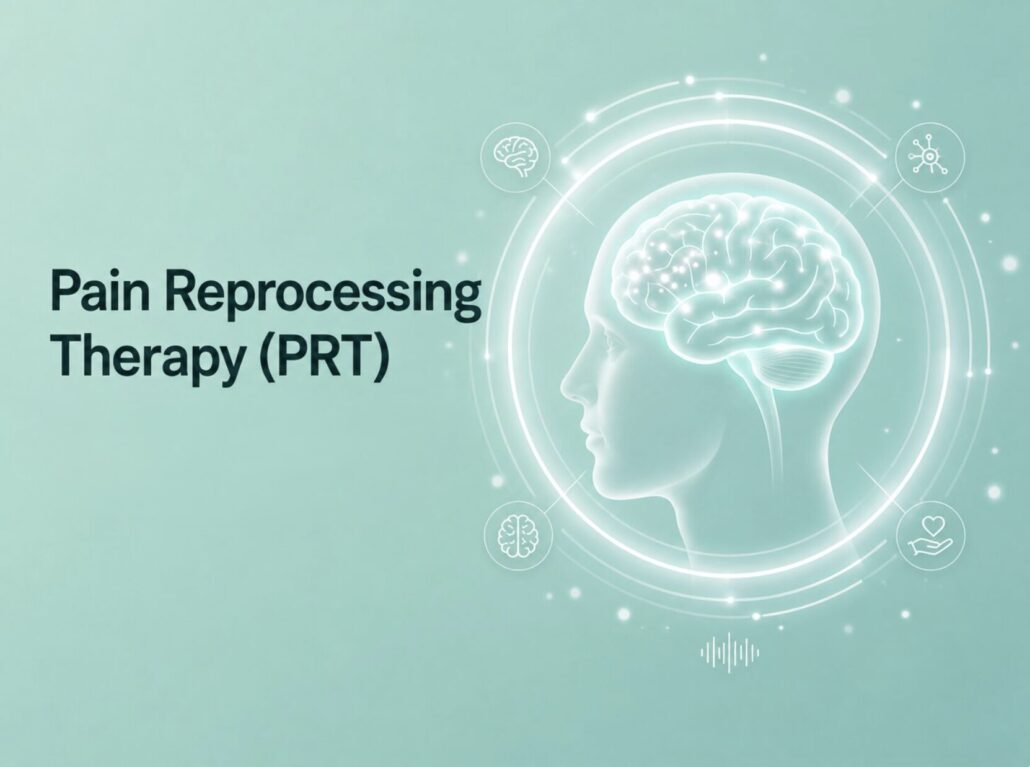
Pain Reprocessing Therapy is an approach grounded in neuroscience to reduce or eliminate chronic pain. Pain Reprocessing Therapy (PRT) is rooted in the premise that certain types of chronic pain are not triggered by structural problems but rather learnt neural pathways in the brain and the dysregulation of pain circuits.
There are a lot of studies that discuss the effectiveness of Pain Reprocessing Therapy (PRT). The most important one is the Boulder Back Pain Study, which was done by the University of Colorado Boulder in the United States. 150 participants have chronic back pain were divided into three groups: The first group had two sessions of Pain Reprocessing Therapy (PRT) weekly for a month, the second group was an open-label placebo group, the participants were injected with normal saline; and the third group was a waiting list group, they continued their usual treatment. The results showed that the percentages of the participants who are pain-free or nearly pain-free after one month are as follows: 66% of the Pain Reprocessing Therapy (PRT) group, 20% of the open-label placebo group, and 10% of the waiting list group. All the participants got a functional MRI before and after the trial, and the image showed significant changes in the anterior insula and somatosensory cortex, which are parts of the brain that are associated with pain, in the Pain Reprocessing Therapy (PRT) group.
Two follow-ups were done after three months and a year; the results indicated that the Pain Reprocessing Therapy group had better improvement than the other two groups. (1)
Based on the previous study results, Pain Reprocessing Therapy (PRT) has proven its effectiveness in reducing or eliminating pain in comparison with other approaches.
We offer Pain Reprocessing Therapy (PRT) in our clinic to the patients we think are good candidates for it as a part of our multimodal approach in treating pain.
Written By: Dr. Shatha AL-TAMIMI
https://pubmed.ncbi.nlm.nih.gov/34586357/