Cognitive Behavioral Therapy (CBT)
Do you have chronic pain? Does the pain affect your quality of life? You have tried the medications, the procedures, and the surgeries – so why is the pain still there? What if I told you the key to managing all that pain is in your mind?
Chronic pain is pain that persists for more than three months. According to available statistics, it affects an estimated 30% of the world’s population. This is a substantial proportion, particularly given the significant economic and social burden that chronic pain and its consequences place on both individuals and societies.
Pain is a warning signal generated by the brain to alert us to danger so that we can respond and protect ourselves. The danger may be as simple as your skin touching something hot, prompting you to pull away in response to the warning signal. In other cases, it may be a brain hemorrhage, leading someone to seek emergency care because of a sudden, severe headache; the bleeding can then be identified and treated before it causes life-threatening complications. Pain is therefore essential in helping us recognize danger and respond to it. Sometimes, however, pain continues even after the underlying physical problem has been resolved—in other words, the brain’s alarm system remains active even though the danger has passed.
Whether or not an actual threat is present, the ongoing alarm signal of pain can trigger negative emotions such as fear, anxiety, or frustration. These emotions may be accompanied by negative thoughts such as, “I will never be able to enjoy my life,” “My life has become unbearable because of this pain,” or “I will never be able to live normally again.” Such automatic negative thoughts and emotions can increase the intensity of pain, which in turn reinforces those same thoughts and feelings, creating a self-perpetuating cycle in which each element strengthens the others. This cycle of suffering may seem impossible to break, but the opposite is true: breaking the cycle is one of the ways to escape this pattern and learn how to manage pain more effectively.
How Can We Break the Cycle of Suffering?
Because the brain is the source of the experience of pain—whether the pain is associated with a physical cause or represents a false alarm—and because the mind is also the source of negative thoughts that can intensify pain, addressing both brain and mind is important. Doing so can help reduce pain or improve the ability to cope with it and live a better quality of life.
Holistic medicine offers several approaches for addressing the psychological aspects of pain. Cognitive Behavioral Therapy (CBT) is one of the most important approaches, focusing on automatic negative thoughts and on reshaping them to help break the cycle of pain.
What Is Cognitive Behavioral Therapy (CBT)?
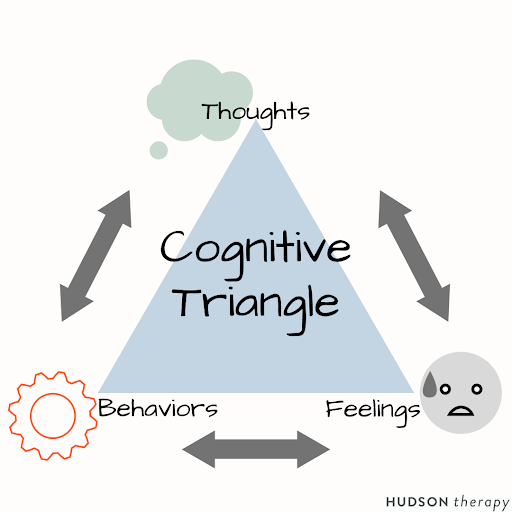
Cognitive Behavioral Therapy (CBT) focuses on the three corners of the cognitive triangle:
- Thoughts: These are the ideas that come to mind, or our internal dialogue, in response to a particular situation. They are usually shaped by our beliefs about ourselves and/or about the outside world and other people.
- Emotions: These are our emotional responses to situations, such as fear, anxiety, anger, and other feelings.
- Behaviors: This is the action we take in response to events.
As the arrows in the triangle above illustrate, the three components interact with one another: each one influences and is influenced by the others. For example, if you have fibromyalgia, pain may lead to thoughts such as, “I am completely helpless,” or “I cannot succeed at anything as long as I am in pain.” These thoughts may make you feel helpless, frustrated, or even angry, and they may cause you to withdraw from your social life. That withdrawal can then reinforce the original thoughts and intensify the associated emotions. In this way, a thought generates an emotion and a behavior, while the resulting emotion and behavior reinforce the thought. Each component can therefore negatively strengthen the others.
To shift the outcome of this triangle in a more positive direction, you can choose one component and work on changing it. A positive change in one area can then positively influence the other two, helping you achieve a better quality of life. Cognitive Behavioral Therapy (CBT) considers thoughts to be the component that is often most accessible to identify, work on, and change.
Cognitive restructuring is a core technique used in Cognitive Behavioral Therapy (CBT). It involves identifying automatic negative or distorted thoughts, evaluating how accurate they are, modifying those that need to be changed, replacing inaccurate thoughts, and adopting more balanced alternatives.
People with chronic pain often tend toward what is known as catastrophic thinking. Their thoughts may contain extreme, absolute judgments such as, “I will never get better,” “Pain has ruined my life,” or “It is impossible for me to return to my normal life while I have this pain.” This pattern of thinking commonly generates fear, which may then lead to avoiding movement. Fear and avoidance can, in turn, perpetuate pain, leaving individuals trapped in the cycle described above.
Cognitive Behavioral Therapy (CBT) aims to identify these catastrophic thoughts, bring them into awareness, analyze them, and reshape them into more realistic thoughts. Treatment is not limited to working with thoughts alone. Other techniques may support this process, including deep-breathing exercises, progressive muscle relaxation, and planning appropriate activities according to the individual’s stage and condition. All of these approaches aim to improve quality of life and help the person return to daily activities as fully as possible.
At Dr. Samer Abdel-Aziz’s clinic, each patient receives an individualized treatment plan. We address both the psychological and physical aspects of pain with the goal of improving overall quality of life.
